Implementing the strategy design pattern in Python.
Design Patterns
Published
April 28, 2024
Modified
August 30, 2024
Numerical integration schemes
Numerical Integration
Calculation of many financial methods or metrics relies on a mathematical tool called numerical integration. In simple terms, numerical integration takes a function that represents a continuous process (like the changing value of an investment over time) and approximates the area under its curve. This area can then be used to calculate important quantities, like the total return of the investment or price of a derivative instrument.
So we are tasked with a problem, and one that has many different ways of solving, or rather approximating the solution. You most likely (taking into account you’re still reading this) encountered rectangle rule, or Riemann summation in your Calculus 101 course/self-learning. But there are many other techniques, which we call schemes.
For quantitative analysts, the choice of the integration method matters. Different integration schemes offer varying levels of accuracy and efficiency. Unfortunately there’s no best technique. Same algorithm can be a perfect fit for problems with As quantitative developers, we need software architectures that let us swap between these numerical schemes without rewriting downstream caller code.
Design Patterns
This is where design patterns come in. Design patterns are reusable solutions to common programming problems. Their widespread adoption in software development is largely attributed to the publication of Design Patterns: Elements of Reusable Object-Oriented Software in 1994. Authored by E. Gamma, R. Helm, R. Johnson, and J. Vlissides (often referred to as the “Gang of Four” or GoF), this book cataloged 23 essential software design patterns. These patterns provided solutions to common design problems in object-oriented programming, promoting code reusability, maintainability, and flexibility.
Some design patterns can feel clunky or inelegant when implemented in Python. The language itself often has built-in features or idioms that achieve the same result in a more Pythonic way (meaning it follows Python’s style and conventions). Sometimes, design patterns can be seen as overcomplicating simple problems. On the other hand, usage of well-known and understood patterns may enhance your engineering skills and improve code readability.
Ultimately, the decision of whether or not to use design patterns in Python depends on the specific context of your project and your coding style. There’s no right or wrong answer. But first, you need to know the classics to diss the classics. We’ll hold on with the dissing for now, cause in the example below chosen design pattern makes for a very clean implementation. You’ll see for yourself.
Strategy Pattern
We know the stage now — one problem statement, multiple strategies to tackle. Important observation here is that we don’t actually care which one is used. When you substitute the integral value to client code — a formula or further algorithm — it’s irrelevant how it was computed, as long its correct to required level of accuracy. This means that the problem should be decoupled from algorithms to solve it. We should target a implementation where you can state a problem Calculate the integral of\(\\sin(x)\)from\(0\)to\(\\pi\) and then just throw different algorithms at it to obtain a solution. So let’s get coding!
Note
I will show you this pattern through an example. If you prefer more generic setup see Refactoring Guru’s implementation. The customary ‘software engineering’ example used to present the SDP is sorting a list of integers using different sorting algorithms.
Abstract Schema
Each scheme that we’d come up with, even the most complex ones, would have the same main purpose — ‘integrate’. To make the implementation for it, we create a template class that all concrete schemes will inherit from.
Show the code
from abc import ABC, abstractmethodfrom typing import Callable1class IntegrationScheme(ABC):"""Abstract base class for integration schemas."""2@abstractmethoddef integrate(self,3 integrand: Callable[[float], float],*,4 start: float, end: float, ) ->float:"""Abstract method for integrating a function."""
1
ABC defines abstract classes, serving as a template. Concrete subclasses inherit from it; abstract classes cannot be instantiated.
2
The @abstractmethod decorator signifies this method must be overridden by all concrete subclasses.
3
Callable annotations define function-like objects that can be executed.
4
Type annotations improve readability and can be used by static type checkers like mypy to detect errors early.
Concrete Schema Implementations
Now that the interface is established, we can implement concrete numerical schemes.
Rectangle Rule
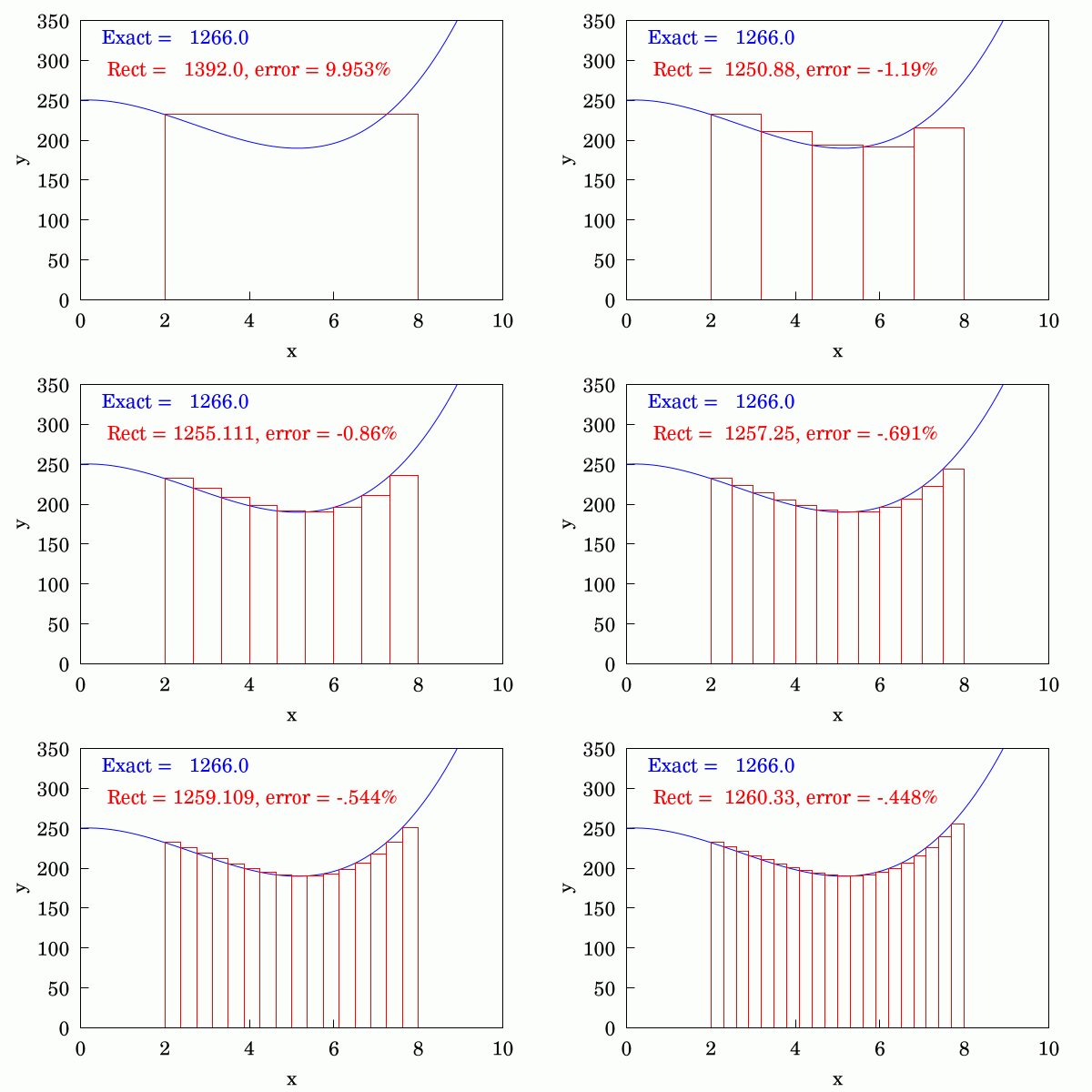
It’s the simplest way of estimating the area under a curve you can think of — cover it with smaller and smaller rectangles with the value of a function at the leftmost point as height constant width.
Approximation of an integral via rectangle rule
Implementing this idea is trivial when using NumPy, but let’s add some syntactic sugar so the class is sweeter to work with.
Show the code
import numpy as np1class RectangleScheme(IntegrationScheme):"""Schema for rectangle integration."""2def__init__(self, steps: int, ) ->None:"""Initializes the rectangle integration config."""if steps <=0:raiseValueError("Steps must be greater than 0.")self._steps = steps3def__str__(self) ->str:"""Returns the string representation of the schema."""returnf"Rectangle schema with {self._steps} steps"4def integrate(self, integrand: Callable[[float], float],*, start: float, end: float, ) ->float:"""Integrates a function using rectangle integration.""" x_points = np.linspace(start, end, self._steps) values = integrand(x_points) dx = (end - start) / np.float64(self._steps)return np.sum(values) * dx
1
RectangleScheme inherits from IntegrationScheme, requiring implementation of integrate.
2
__init__ sets up the rectangle count, including validation for positive values.
3
__str__ customizes the string representation of the class instance.
4
integrate performs the calculation: linear spacing, function evaluation, and summing area elements.
Simple Monte Carlo
This guy sounds fancy with its luxurious Monaco vibes, but it’s just a peasant in a nice suit. Instead of looking at equaly-spaced points, we shuffle them from uniform distribution on the interval of integration. We calculate the integrand function values at those points and sum them up. Then multiply the sum by the average distance between points and through the magic of probability theory (and not opening actual probability textbook in 10 years) you get a good probabilistic estimator of the integral value. The implementation is analogous to the RectangleScheme.
Show the code
from typing import Optionalclass MonteCarloScheme(IntegrationScheme):"""Schema for Monte Carlo integration."""1def__init__(self, random_points: int, random_seed: Optional[int] =None, ) ->None:"""Initializes the rectangle integration config."""if random_points <=0:raiseValueError("Points must be greater than 0.")self.__random_points = random_pointsself.__random_seed = random_seeddef__str__(self) ->str:"""Returns the string representation of the schema.""" points_msg = (f"Monte Carlo schema with {self.__random_points} random points" ) seed_msg = (f" and seed {self.__random_seed}"ifself.__random_seed else"" )returnf"{points_msg}{seed_msg}"def integrate(self, integrand: Callable[[float], float],*, start: float, end: float, ) ->float:"""Integrates a function using Monte Carlo integration.""" np.random.seed(seed=self.__random_seed) x_points = np.random.uniform(start, end, self.__random_points) values = integrand(x_points) average_dx = (end - start) / np.float64(self.__random_points)return np.sum(values) * average_dx
1
Optional[int] allows random_seed to be an integer or None, defaulting to None for non-reproducible results. Note: int | None is preferred in Python 3.11+.
Note
The Optional stands for could be None as well, it doesn’t affect if the input is mandatory or not. In our case it’s not, but thats stated by the = None part. In Python 3.11 onwards it’s recommended to use int | None instead.
Integrator
What’s left is to have a way of defining the problem to solve and define how our schemes (strategies) interact with it.
Show the code
"""An integrator class that allows to perform integration using different schemas."""from typing import Callableclass Integrator:"""An integrator class that allows to perform integration using different schemas as strategies."""1def__init__(self, integrand: Callable[[float], float], interval_start: float, interval_end: float, ) ->None:"""Initializes the integrator class."""if interval_start >= interval_end:raiseValueError("Start value must be less than end value.")self.__integrand = integrandself.__interval_start = interval_startself.__interval_end = interval_end2def__call__(self, schema: IntegrationScheme, ) ->float:""" Calculates the definite integral value of a function. Args: schema: integration schema """print(f"Using {schema}.")return schema.integrate(self.__integrand, start=self.__interval_start, end=self.__interval_end, )
1
The __init__ takes in the obvious parameters — function to integrate, start and end of the interval. It also checks if it’s a proper integral.
2
We get to implement our own __call__ method now. It’s clear what Integrator class does. No need to have a method with a descriptive name like Integrator.integrate. To use it you pass through the integration scheme into the integrator — notice annotation of the abstract IntegrationScheme. It prints the info on strategy used (using the __str__ methods) and calls integrate method of the scheme. No care in the world on how the value is actually calculated.
Let’s Integrate
Ok, now to the integrating! Let’s set up the stage:
We should get some benchmark value first. As none of us would bother to integrate this by hand, we’ll use SciPy. Unexpectedly (SciPy uses C and Fortran underneath), we get the result in a breeze and it is very close to actual value of 2.0.
Show the code
from scipy.integrate import quadscipy_quad, err = quad(f, start, end)print(scipy_quad)
1.9999999999999998
Now let’s use our Integrator class and see.
Show the code
integrator = Integrator( f, interval_start=start, interval_end=end,)iterations = [2**i for i inrange(0, 21, 5)]rectangle_results = [integrator(RectangleScheme(steps=i)) for i in iterations]mc_results = [ integrator(MonteCarloScheme(random_points=i)) for i in iterations]print(f"Rectangle scheme results:\n{rectangle_results}.")print(f"Monte Carlo scheme results:\n{mc_results}.")
Using Rectangle schema with 1 steps.
Using Rectangle schema with 32 steps.
Using Rectangle schema with 1024 steps.
Using Rectangle schema with 32768 steps.
Using Rectangle schema with 1048576 steps.
Using Monte Carlo schema with 1 random points.
Using Monte Carlo schema with 32 random points.
Using Monte Carlo schema with 1024 random points.
Using Monte Carlo schema with 32768 random points.
Using Monte Carlo schema with 1048576 random points.
Rectangle scheme results:
[np.float64(1.5707963267948966), np.float64(1.986172817555692), np.float64(1.9995804632216618), np.float64(1.9999869013603688), np.float64(1.9999995906791064)].
Monte Carlo scheme results:
[np.float64(1.9090181082516768), np.float64(2.0326418966261413), np.float64(1.9864796407984007), np.float64(2.00008414937565), np.float64(1.9997837198557311)].
The convergence of these simple numerical implementations is relatively slow. For production systems, intensive numerical integration is offloaded to vectorized C/Rust extensions or compiled with Numba. Furthermore, production libraries like SciPy employ adaptive quadrature algorithms refined over decades.
The real win here is architectural: look how cleanly the problem definition is decoupled from the specific algorithm used to solve it.
If you want to implement higher-order algorithms (such as stratified Monte Carlo or adaptive quadrature), you simply subclass IntegrationScheme. No alterations to existing business logic or caller functions are required. That is the Strategy pattern at its best.